Sunday, November 11, 2007

Family: The Realization.


"The family is one of nature's masterpieces." --George Santayana

Growing up, I was told that family is and should always be number one; that when no one else is there to pick you up when you are down or forgive you for the unforgivable, your family will be. Despite being told rather continuously, I did not always appreciate that truth that it encompassed.

As a young child, and even into adulthood, I tended to have a bad temper and become extremely irrational when upset. When I was younger and was told that something would not go my way, I would break out into tears, stomping my foot and demanding that I get what I want. This, of course, was unreasonable and my parents recognized “the more they lavished their care upon her…the more drooping she became” (1040). If they were to dote on me after such a temper tantrum, I would continue acting in this inhumane and completely ridiculous manner. Hence, they would refuse to give, and I would often wind up in a foul mood without getting what I wanted.

Of course, as the years passed, my reactions to these types of situations changed. I went through a stage, like many do, when I did not think of the way I was treating my parents and took everything for granted. I would let my temper get the best of me and yell hurtful things to my parents, things I am forever sorry for saying. I would then watch them, their “faces were as if masked, like masked dancers in a supernal drama, for the thought in their eyes was not of this world” (1061). Their minds spun as they tried to understand how I had come to be able to say those things to them. But no matter what I ever said or how hard I stomped my foot,
when I grasped how wrongly I acted and was ready to apologize, they were always there with a lecture but still a big huge waiting for me.

Years passed and I began to realize the importance of my family. I developed extremely strong bonds with my siblings and parents as well, sharing more about my life and coming to appreciate the greatness that defines our family. My family never was separated or distant, even when I would have my outbursts, but without the outbursts, I found that we could be even more close-knit.

This past July, my mother’s sister and my aunt, Aunt Nanci passed away after a year and a half long battle with cancer. It began in her liver and by the time they caught it, it had begun to spread to her lungs. Eventually, she had surgery to remove the cancer, but the recovery was long and hard and in the end, she lost the battle. It was during this time that the meaning of family was truly emphasized and demonstrated very clearly.
After Aunt Nanci found out about her illness, my grandpa, her father, was diagnosed with Lymphoma and my grandma, her mother, with breast cancer. It seemed that we had been dealt and unfair hand were stuck with an unreasonable amount of suffering.

My mom had always been extremely close to her parents, calling them to chat every single night. After Nanci got sick, my mom talked to her every day as well. Often times, Nanci “spoke with great spirit and determination” (1068), but there were days when she could do nothing but cry, too weak to get out of bed, hoping that tomorrow would be a better day. My mom was there for Nanci through all of it, from the day she was diagnosed till the day she passed away, holding Nanci’s hand in the hospital bed while she allowed her body to let go.

When I found out about my aunt’s death, I was in a state of shock. I had known her illness was worsening and that chances of her survival were very slim, however it wasn’t until a while after her death that it all hit me. I “lay still a moment collecting [my] thoughts” (1069) and grasped the reality that I would never again go to Nanci’s house on one of my visits to Ohio and see her moving briskly about the kitchen, making cookies and goodies for anyone who passed through. I would never go shopping on a cold winter day, or to lunch at J. Alexander and then to a movie. Or to see her beautiful horse and watch the joy spread through her body as she brushed his mane and fed him treats. She was gone…forever.

As tough as it was for all of us to deal with my aunt’s death, it has brought our entire family much closer and highlighted the importance each of us is in the others’ lives.
I have grown up a lot the past few years in a number of ways, from putting a damper on my temper to being able to deal with “the sense of freedom” (1069) that I have in college, to being able to deal with the truly difficult emotions that come along with losing someone close to you. Going to UT rather than Michigan, I am able to remain close to my family and see them regularly, and I always remember that no matter what, “family preceded anything else” (Charlotte Bealle).

Monday, November 5, 2007

Strenght and Honesty in Many Forms


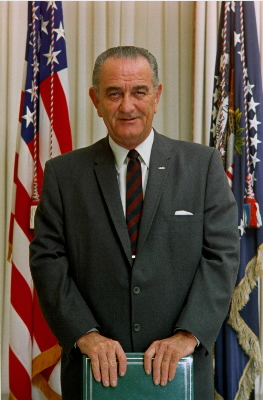
I really enjoyed the LBJ museum and all of the exhibits that it is composed of. I found that most of the people documented in the museum were known for positive contributions to society. There were the few people and time periods that were known for negative things, such as the man who shot John F Kennedy and the time when slavery was legal, but the majority were upstanding citizens and times of success and progress. When I began looking around the museum, I came across the first exhibit of Lyndon Baines Johnson and his family. I found it fascinating that his grandpa expected “him to be a US Senator before the time he was forty.” Amazing!

Being a first child and a brother to two sisters, I can imagine that LBJ had quite a bit of pressure put on him to perform well in all that he did. I admire that he was able to step and do so, despite the odds he came across.
lady_bird_johnson.jpg" border="0" alt="" />It is also very inspiring to know that he participated in fun things such as being a leader in camp activities at Southwest Texas. I am very involved in leadership camps so it is nice to know that one can spend time doing those kinds of things and still be successful in the long run. From being the Texas State Director of National Growth Administration to a Congressman and Senator to an Officer in the US Naval Reserve, he was about as well rounded as it gets. His lovely wife, Claudia Johnson, most commonly known as Lady Bird, was adorable and very bright as a child.

Growing up, Lady Bird didn’t have as many great opportunities as LBJ did and many other children. She learned most things from her Aunt Effie and did not live her childhood in a typical manner. Many people who have hard childhoods come out of it in very bad shape, whether extremely angry at all of those who hurt them or certain that their lives are not worth living and they have messed up to a degree that is unfixable. She failed to live life that way. Rather, she attended the University of Texas at Austin, majoring in History and Journalism. Once LBJ become involved in politics, she too became very involved in many things, including the Senate Auxiliary Events.


Lady Bird leads me into what I found to be the most interesting and tear-jerking exhibit of the entire museum: John F Kennedy’s assassination.
When you enter the exhibit, a tape begins to play, one of Lady Bird Johnson speaking about Kennedy’s death and the events that led up to it. Listening to the honesty and sadness in her voice pulled at my heart and my eyes swelled up with tears. I admire that Lady Bird was able to be so honest about her feelings and portray those feelings in such a way to others. It takes a strong man, LBJ to step up as President of the United States after such a tragedy, but he could not do this without a strong wife right beside him, supporting him all the way.

After Kennedy was assassinated, Jackie, his wife,
wrote a very heartfelt note to LBJ, thanking him for taking over the position and being such a source of support during the hard times. She also asks that some of Kennedy’s things remain in his office the way he would have liked them to be. Once again, tears filled my eyes as I imagined a widowed Jackie sitting at her desk writing the hardest letter she would ever have to write. Her strength to continue and positive outlook are extremely impressive and honorable.

Overall, many of those depicted serve as positive role models in my mind and I would gladly emulate many of the characteristics they possess. It is through people such as these that our city, our state, our country, and our world can grow and become powerful and united.

Sunday, November 4, 2007

Nature's Own


"Study nature, love nature, stay close to nature. It will never fail you."
-Frank Lloyd Wright

Coming to the University of Texas at Austin, I had a pretty good idea of what my life would be like…or so I thought. I pictured myself getting up for class with the sun shining through my window. I would have a nice breakfast as I listened to music and packed my bags. Walking to class, I would enjoy the beautiful day that I was about to take on, thinking about how fabulous it is to be at a school like UT.

All of my predictions were not incorrect. However, they were not all correct either, by any means.

On a typical day, I wake up and sit in bed quietly, wolfing down a bowl of Special K cereal before hoping up to prepare for the day. I then scramble through my drawers, keeping the music off the noise down to ensure I don’t wake my sleeping roommate. Blurry eyed, I make it to the bathroom and proceed to brush my teeth, throw my hair up, and jam my contacts into my eyes, racing through the process and rushing out of the door. I hurry to class, speaking briefly with my parents, beginning to ponder the enormous amount of work I have to do. This reality of my life is quite different than I had pictured it.

Another major difference is the mental state I have taken on since beginning school. Yes, I heard college was hard. But how hard could it be? That question was answered when I bombed my first Chemistry exam after attempting to cram it all in last minute, “notebook after notebook” (738) full of information I failed to remember, the way I did in high school. But “how do I anticipate coping with such pressures that reality imposes on me?” (Julie Chang). And on came the stress…

And with the stress came the need to study…a lot. Luckily, I found a variety of places that suited me quite well. One was the library in the Tower, located on the second floor. The silence of the room beckoned me to study, sunlight streaming in to shimmer on the faces of the diligent students sitting and working for hours. Outside, the gardens beneath me served as a sort of fortress protecting me from the outside world, keeping those unwilling to study out of the area. The green grass and bellowing trees created a very serene environment. I felt at peace as I sat in the large, cozy chair tucked inside this great Tower.

After staying inside many days studying, I decided the weather had become mild enough to enjoy the outdoors. I chose a nice spot in the six-pack near the Tower gardens. I even went as far as bringing a towel to sprawl out on and plenty of study materials to last me the afternoon. By this time of the year, the stress had begun to accumulate and the walls of the PCL were not very inviting. The grass and gardens seemed to be the perfect place. As I sat on my towel, I saw “all kinds [of people] come through the [garden] and come at all times” (732). I was getting a broad view of the diversity this campus possesses. There were athletes, punks, intellects, professors, fraternity and sorority members, and everything in between. The campus belonged to me; I knew it better than anyone else did at that moment as I observed its many components. Occasionally I would “break off and acknowledge the pleasant greetings of people when [they] passed,” (731) but for the most part, I was in my own serene and peaceful world.

Like Margaret, when visiting the Taniguchi Gardens, “I grasped with visceral reaction a sense of inner harmony. I struggle to reconcile these two worlds: one filled with daunting yet necessary responsibility, and the other a place of undulated appreciation and conciliation” (Margaret Clemons). I wanted so badly to sit and enjoy the wind rustling the bushes, the fish swimming through the pond, the light peaking through the trees. I knew, however, that I had work to do and to simply enjoy would not be using my time wisely. Sometimes, it is necessary to put all work to the side and live in the moment, live in the garden, live through nature. It is truly special and precious when we can combine, hammer, if you will, our desire to be in nature with our need to be productive. This is when we truly can stand out while remaining calm and grounded.

Nature and the outdoors do amazing things when used in the right way. I find myself to be more relaxed and at peace with my reality and everything required of me when I am outside, whether laying on a towel in the gardens or sitting at a table on the Starbucks porch. Going into this next week, I have a tremendous amount of work to be done, however I know that with nature on my side and the power of relaxation, I will be able to get through it successfully and with as little stress as possible.

Tuesday, October 16, 2007

A Perfect Representation of UT

College Expectations

“I feel like everyone who goes to The University of Texas is blessed and lucky to be there because they're getting a chance to be as good as they can be.” –Alan Bean

Reading back over my original expectations of the University, I found that all of my expectations have either been met or have begun to be met. To begin, the freedom is unbelievable. When I first got here, I would have random feelings of nervousness. I was unsure as to what was prompting these odd feelings but soon realized exactly what it was: I was so enthralled with the freedom and college life and still so unaccustomed to it that I felt it was unreal, that some one was going to come steal me away, pull the rug out from under me and bring me back home to my parents and curfew and rules. A couple weeks passed and it finally set in that I was, in fact, going to stay at the University and my nervousness subsided. I have since had many challenging lessons dealing with freedom, from TIME MANAGEMENT, to right versus wrong, to safety issues. One week in particular, I got a total of about 12 hours of sleep, which made for a difficult time in staying awake during classes. I have had to decide whether certain situations, such as walking home by myself late at night, are safe. Overall, I have done quite a good job of managing my time and making decisions. I am sure I will make more mistakes and have more weeks with only 12 hours of sleep, but my ability to use my freedom in a positive way will continue to better as time passes.

Friend-wise, students here at the University never cease to amaze me. It seems there is always an odd character lurking around the corner, waiting to introduce himself and become a new friend. My “college best friend” entered my life early in the year with her constant giggling and “Hi! I’m Kristin! Smiling’ my favorite!” kind of attitude. From her intelligence and interest in travel and sports to her willingness to burst into song and dance as we walk down the drag from a late night visit to Kerby Lane to our long discussion on topics varying from religious beliefs to our current crushes, she has been a bright light in my college experience thus far. During my sister’s (she seems to appear in my entries quite often) first semester at UT, she became best friends with Melissa, a friendship that has blossomed and grown stronger over the years. I have a feeling that Kristin will be my Melissa, a friend on all fronts that will last for years to come.

The opportunities at UT seem to be endless in their magnitude and their contents. Already, the opportunity to study at Oxford has presented itself, which is “for some…the perfet place for contemplation, for others a protective environment within which to indulge their fancies” (636). Unfortunately, I don’t think I will be able to go on this fabulous excursion due to the $10,000 it would cost for 6 weeks, however I know that I will have many more chances to do things like this.

As I read Freddie Steinmark’s tragic story of his battle with cancer, I found me eyes swelling with tears and a feeling of chills overcoming my body. Maybe this is because I can so closely relate with terrible toll cancer takes on one’s body, from my aunt, to my grandma and grandpa to a scare with my mother. Or perhaps it is purely the amazement I feel that one man can make such an impact on not only his teammates and the future team, but the University as a whole. Over three decades later, “80,000 empty seats [are] filled by the Orange-blooded faithful who have come from every where from Jester West to the West Coast to catch a glimpse of the…Longhorn football team” (172). Like many, coming to the University of Texas I wanted “scholarship, new experiences, and freedom from [my] past self” (177). UT has so much to offer, from its tradition of excellence to its outstanding athletics to the diversity that defines it.

Currently, my expectations remain similar to my previous expectations. I plan to grow as a person, gain knowledge, meet friends, and experience Austin. Sometimes, I find myself thinking that Austin is “not a real city at all but a fiction, a vision and an illusion” of something so great and so different that it could merely not exist in real life. This point is reinforced as I sit here writing my paper in Starbucks, watching individuals from all walks of life pass in and our of the small coffee shop, each with their own story, their own truth. I am continually surprised by the events that seem to jump into my life and take me on adventures I could have never imagined. It seems there is always "a spot a bit brighter" (652), somewhere just around the corner that has more to offer, a greater opportunity awaiting me. I hope everyday that these adventures continue and take me to the wildest of places.

Monday, October 15, 2007

My Wonderland

College. For some, college is a time of freedom where all that matters is how many parties you can fit into one night, one weekend. For some, college is a time to realize that college isn’t for them. And for some, college is time for discovering their destiny, what life holds for them. For me, I feel like it is a combination of all these that defines college. Of course, my definition does not merely piece together these various definitions, but rather the concepts behind them. It is a time for going out, making friends, exploring the city of Austin. It is a time I will certainly fail at some things and learn my strengths and weaknesses. And of course, it is a time for me to lay the foundation for my future, my family, my career.

We come to college having known certain things our whole lives, whether assumed or told. As I entered onto the University of Texas campus, I “[began] to think that very few things indeed were really impossible” (Alice’s Adventures in Wonderland 16).
My weeks here at the University have opened my eyes to the wide range of possibilities, each door waiting to reveal a new possibility, a chance to take “the rapid journey through to air” (Through the Looking-Glass 14) to the unknown and undiscovered territory of college life.

We grow up with accepted truths, “a red-hot piker will burn you if you hold it too long; and that, if you cut your finger very deeply with a knife, it usually bleeds” (Alice’s Adventures in Wonderland 17). I believe that college is a time reject some of these truth. Now, don’t go cutting your finger with a knife to see if it will truly bleed, but challenge yourself intellectually, spiritually, physically, emotionally. Take a course you have never dreamed of. Investigate your belief in a high power and re-secure your faith. Opt to keep off the infamous “freshman 15.” Become friends with an unlikely character. Try to find meaning behind the impossible representation of a box pictured here.

I have found that my encounters with individuals thus far has many parallels with Alice’s encounters in Wonderland, each of her encounters “a parody of the freshman’s encounters with other freshman at UT” (678). Unlike Hannah, I did not “find my new college experience devoid of life.” Rather, “I came to UT knowing that some of my high school friends would be accompanying me to this large University. However, I chose to stray from the majority of these friends. Having been with them since middle school, I was anxious to make new friends, find the unlikely companion that so many speak of meeting in college. Just as Alice found “an enormous puppy looking down at her with large round eyes, feebly trying to touch her” (Alice in Wonderland 44), I have found others reaching out to me in hopes of forming a friendship, unsure of where it will lead. In the past month and a half, I have become great friends with someone very similar to me and still very different. This fairly unlikely companion has shown me that, once again, anything is possible; and that is what college life is about.


After Alice’s first odd meetings with those in Wonderland, “Alice had got so much out into the way of expecting nothing but out-of-the-way things to happen, that it seemed quite dull and stupid for life to go on in the common way” (Alice’s Adventures in Wonderland 19). I now know that my next four years will be full of the unexpected, and I must be prepared to take on each of these unexpected occurrences. I have yet to come across a Cheshire Cat who fails to remove the smile from his face, or a hookah-smoking Caterpillar, however, I wouldn’t put it past Austin and the University of Texas to create either of the two. As Joe Nichols says in his song "The Impossible," "sometimes the things you think would never happen, happen just like that...i've learned to never underestimate the impossible." As we know, here, anything is possible.

Monday, October 8, 2007

Liberal Education


“It is not so very important for a person to learn facts. For that he does not really need a college. He can learn them from books. The value of an education is a liberal arts college is not learning of many facts but the training of the mind to think something that cannot be learned from textbooks.”—Albert Einstein

Education and knowledge can take on a broad range of definitions. The standard definition of knowledge is “facts, information, and skills acquired by a person through experience or education; the theoretical or practical understanding of a subject” (Oxford American Dictionary). Going by this definition, it seems fairly simple to acquire and obtain knowledge; after all, we go in and out of each day having a variety of experiences and taking a little bit from each of them. At a University, students take on the task of gaining extensive knowledge and mastering a chosen topic, ranging from history to foreign language to chemistry. The opportunity is set forth through classes focused on a particular subject area and the small variance in class options. However, in the College of Liberal Arts, one is given an extension of this opportunity. One is given the chance to gain knowledge not on one, but on a variety of topics, connected or independent of one another.

Many think, “Why study so many topics when in the end, you must choose one area to pursue a career in?” This is an extremely valid argument, one I struggled with myself when considering what to major in. As a science major, which would have been my second choice, similar to John’s, the majority of my classes would have consisted of memorizing information and being able to quickly spout off the process of DNA replication or identifying compounds and formulating their Lewis Dot Structures. As much as this applies to my future in medical school, the idea of four years of pure science followed by another four year of pure science was not as appealing and Plan II where exploration of topics was encouraged.


Newman states that, “Each of us needs to find our own truth; if and when we do, we will become free, liberated, one of the most important meanings of the phrase ‘liberal arts’” (320). John challenges each of us to “Constantly reconsider [our] paths” and to search for our true passion. So far this year, I have begun to discover my passions in a deeper sense; I have wondered whether my true calling is medicine, whether I will fail out of college, whether I will get a degree and still be unsure of what I want to spend the rest of my life doing. But as Giametti says, “as [we] now look forward to what lies just ahead, and to all it can mean, there of course will arise in each of [us] normal anxiety” (321). Despite my near certainty of going into medicine, I find comfort in knowing that I am keeping my options open and allowing my knowledge to expand beyond the scientific world. “A liberal education provides a broad base from which to grow,” (Wiley) and “does not merely provide us education in one area, but in many so that we can seek different areas of curiosity and discover interests in fields that we didn’t even know existed” (Julie Paik); Plan II is the epitome of a broad education that prepares us for whatever the future may hold. It is a funnel filled with knowledge and different experiences that results in our future, in the specific area we choose to dedicate ourselves to.

Through our World Literature course, we are challenged to evaluate not only ourselves but our role models, those we look up to. “Almost all knowledge of the inner nature and feelings of others must come through the imagination,” (Sympathetic Imagination) thus our interactions on Second Life are key in opening up our imagination and allowing the knowledge of those feelings to flow. I highly doubt we would be able to use technology in this way as a Biology or Engineering major. Liberal Arts allows us to go beyond the normal and experience the extraordinary while paving the way for our future.